
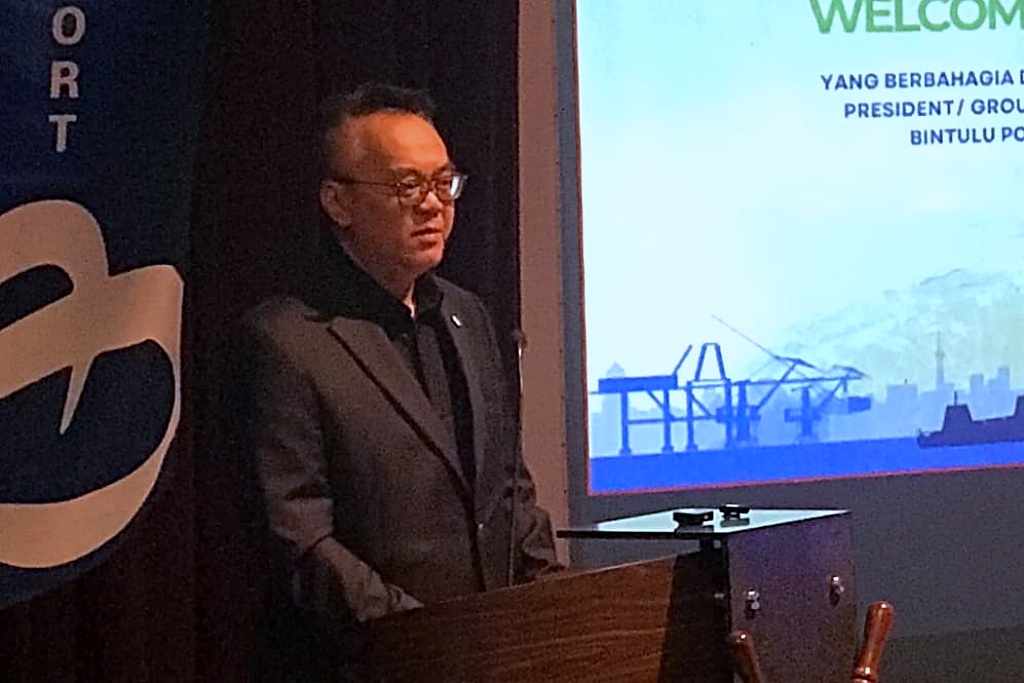
BINTULU (Nov 26): Bintulu Port Holdings Berhad (BPHB) president and group chief executive officer Dato Ruslan Abdul Ghani outlined an ambitious roadmap for the port’s transformation, aiming for full integration by 2026, full digitalisation by 2030, and complete fully automation by 2050.
He made these remarks at the inaugural Bintulu Port Digital Day 2025 (BeDigital25) at Menara Kidurong on Tuesday, Ruslan said the event marks a historic milestone for the port as it accelerates its shift towards a smarter, greener, and future-ready operating environment under the theme ‘Technology Towards a Greener Future’.
Reflecting on the port’s early steps, Ruslan said digital transformation began with upgrading legacy systems, strengthening network and cybersecurity, and moving from paper-based processes to digital imaging.
“In the last two to three years, we accelerated the effort. We moved from experimenting with digital tools to deploying real solutions that deliver tangible impact,” he said.
He noted that a dedicated Digital Division was established, guided by the Digitalisation Framework 2023, which outlines clear milestones for the port’s transformation.
Ruslan highlighted several key milestones: full integration by 2026 to enable seamless real-time data flow across operations, full digitalisation by 2030 to streamline processes and enhance customer service, and full automation by 2050 using advanced robotics, artificial intelligence (AI) and autonomous systems.
Several ongoing digitalisation projects were cited as examples of progress. Autonomous nested drone now monitor traffic, vessel movements, and potential hazards, allowing the port to replace three patrol boats with a single drone, delivering both cost savings and greater coverage.
The BePASS smart gate and access system, using licence plate and facial recognition, has reduced truck clearance times from over 15 minutes to just seconds.
A modern port operating system (POS) integrates marine, yard, berth, and cargo operations into a single platform, similar to world-class ports such as China’s Yangshan Phase 4.
Other initiatives include AI-enabled CCTV and surveillance to improve safety, network upgrades supporting IoT, 5G, and digital twins, and Customer Centric Centre (CCC) to reduce processing steps from 15 to two, and the BookAjak shuttle system, an in-house ‘Uber/Grab-like’ application for employee mobility.
“These are only some of the initiatives we introduced in the last two to three years alone. Imagine what we can achieve in the next five years,” Ruslan said.
He also emphasised the port’s New Way of Working (NWOW), which empowers staff, partners, users and agencies to collaborate effectively through digital tools, real-time information and a culture of continuous learning.
NWOW delivers faster services and updates for customers, greater transparency for business partners, improved compliance and data sharing for government agencies and smarter tools and smarter workflows for employees.
“But transformation does not stop here. Our next leap is to integrate these systems into a single digital ecosystem, where data flows seamlessly across departments and decisions are made with precision,” he said.
Ruslan outlined the next phase of transformation, envisioning a predictive model powered by real-time analytics, a connected port leveraging IoT and automation, an intelligent port leveraging AI for productivity and safety, and an automated port operating with speed and precision.
While technology is central, he stressed that people remain the heart of transformation. - The Borneo Post