
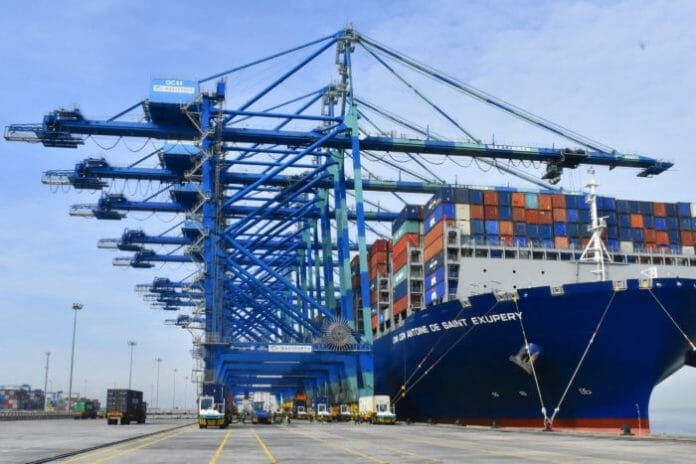
A major shift took place at Bintulu ports on its transfer from the federal government to the Sarawak state this year this development has prompted Kenanga Research to upgrade the operator to “Outperform” from “Market Perform”, citing stronger earnings prospects from an expected port tariff increase, resilient global trade flows and Malaysia’s growing role as a beneficiary of supply chain diversification.
The research house also raised its discounted cash flow-based target price for the stock by 32% to RM7.00, from RM5.30 previously, making Bintulu Port its new top pick in the Malaysian ports and logistics sector.
Tariff hike expected from 2027
Kenanga’s more bullish outlook is based primarily on its assumption that Bintulu Port will receive a cumulative 30% port tariff increase, implemented in stages over three years beginning in 2027.
The research house expects the tariff adjustment mechanism to mirror the three-stage container tariff revision previously approved by the Ministry of Transport for Port Klang operators.
However, it left its earnings forecasts unchanged for now, noting that 2027 will likely be a transition year as Bintulu Port negotiates new commercial terms with its largest customer, Petronas, whose liquefied natural gas (LNG) business contributes around half of the port operator’s revenue.
The full earnings impact from higher tariffs is expected to materialise from 2028 onwards.
WTO sees trade growth holding up despite geopolitical risks
The World Trade Organization (WTO) continues to project global merchandise trade volume growth of 1.9% in 2026 and 2.6% in 2027, supported by strong demand for artificial intelligence-related products, supply chain restructuring and the absence of widespread retaliatory tariffs.
Nevertheless, the outlook remains vulnerable to escalating geopolitical tensions, particularly in the Middle East.
According to the WTO, prolonged conflict between the United States and Iran and persistently elevated oil prices could reduce global merchandise trade growth to 1.4%, shaving 0.5 percentage points from current forecasts.
While Brent crude prices have retreated since early June following renewed US-Iran peace discussions, Kenanga noted that negotiations remain volatile and fragile, leaving uncertainty over the sustainability of lower energy prices.
Shipping adapts to prolonged disruptions
The report noted that global shipping companies have largely adapted to the prolonged disruption in the Red Sea by rerouting vessels around the Cape of Good Hope, transforming what was initially viewed as a temporary diversion into a more permanent logistics corridor.
Shipping lines have restructured fleet deployment, fuel supply networks and freight pricing to accommodate the longer routes while passing higher operating costs through the supply chain.
Despite ongoing geopolitical disruptions in both the Red Sea and Strait of Hormuz, Kenanga highlighted that Asia-Europe trade accounts for only about 17% of global container traffic, while intra-Asia trade represents roughly 62%, limiting the overall impact on Malaysian ports.
Malaysia emerging as trade diversion beneficiary
Closer to home, Kenanga believes Malaysia is increasingly benefiting from global supply chain realignment as multinational companies diversify manufacturing and export routes amid ongoing US-China trade tensions.
The research house noted that Malaysia, alongside Singapore, Vietnam and India, has emerged as one of the region’s key “connecting economies”, facilitating trade across competing geopolitical blocs.
Supporting this view, Malaysia’s exports to the United States surged 97.7% year-on-year in May 2026, driven largely by robust demand for electrical and electronic (E&E) products.
The United States has also remained Malaysia’s largest export destination since February 2026.
Kenanga expects the domestic logistics sector to continue expanding steadily, underpinned by booming e-commerce activity, rising AI-driven data centre investments, resilient US economic growth and ongoing trade diversion.
The research house forecasts Malaysian container throughput to grow around 4% in 2026, with the country’s ports benefiting from their heavy exposure to intra-Asia shipping routes that are less affected by higher US tariffs.
Federal handover strengthens Bintulu Port’s strategic role
Kenanga also highlighted the completion of the historic transfer of the Bintulu Port Authority from the Federal Government to the Sarawak Government on June 21, 2026.
The agreement, which included RM1.8 billion in compensation for the acquisition of strategic port assets, shifted regulatory oversight to the Sarawak administration while leaving port operations under Bintulu Port Sdn Bhdunchanged.
The research house believes the transition provides greater regulatory certainty while preserving business continuity.
Fuel subsidies cushion logistics sector
On domestic operating costs, Kenanga said rising diesel prices have had limited impact on logistics companies because eligible operators continue to receive subsidised diesel under the SKDS 2.0 programme at RM2.15 per litre using approved fleet cards.
Meanwhile, port operators, which are not eligible for subsidised diesel, have mitigated higher fuel costs through fleet electrification initiatives and investments in renewable energy, including solar-powered facilities.
Looking ahead, Kenanga cautioned that tightening environmental regulations, particularly those introduced by the International Maritime Organization (IMO) and the European Union, could pose longer-term challenges for global shipping and trade flows.
Despite these structural risks, the research house remains positive on Malaysia’s ports sector, believing that continued supply chain diversification, resilient regional trade and favourable tariff revisions will underpin earnings growth, with Bintulu Port standing out as the sector’s preferred investment.